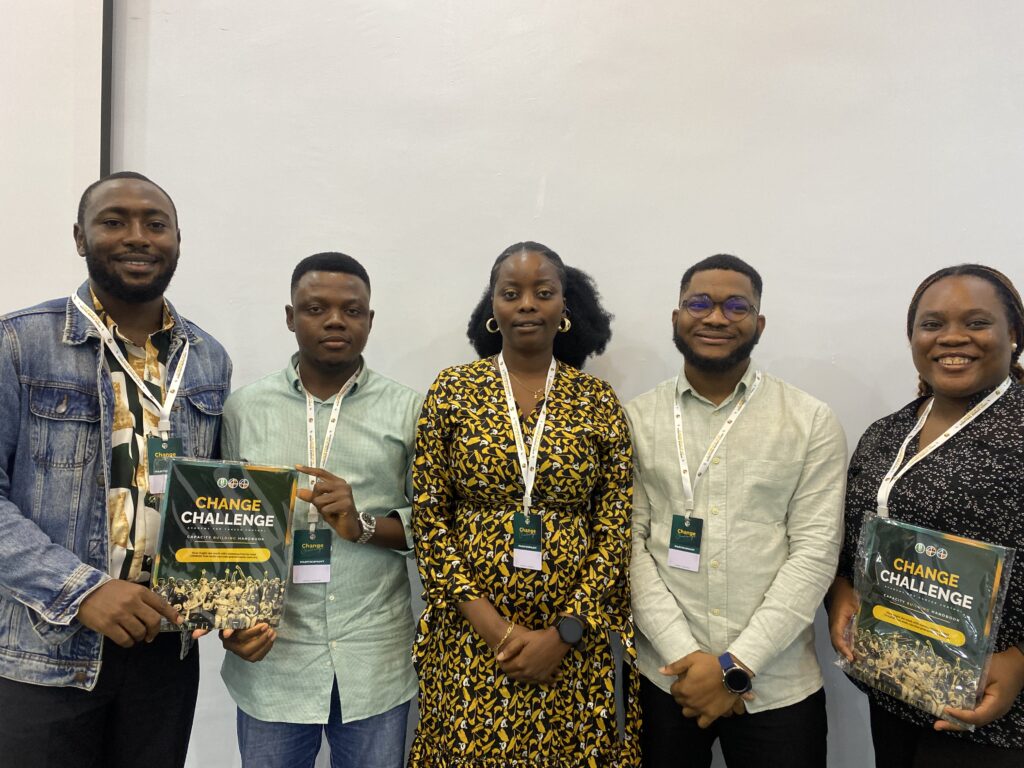
The deliverable I’m taking back – A personal reflection of a 2026 Change Scholar.
I’d like to declare that there was no use of AI in the conceptualization or writing of this essay.
Well, except for Grammarly correcting some punctuation here and there, which I had no
control over. smiles
If I had successfully conducted research and published a paper, it would likely have taken —if
at all it would— seventeen years before it would have benefited any patient or person. To satisfy
your curiosity, dear reader, I will answer why. To do this, I will ask you to work with me to
discover why.
What comes to your mind when you hear research? To publish a paper, right? Then answer
sincerely, how many times have you thought of what comes after? If you ever did, perhaps
you’d think of conferences to tell the world about your paper. Ponder for a second, are you
telling the world or are you telling a room that feels like the world?
I’m in my first year of Oncology residency, and I have thought of a plethora of problems I’ve
seen and would like to solve. I have drafted proposals about seeing the effectiveness of
exercises in cancer patients undergoing radiotherapy, assessing awareness and attitudes
towards chemo-ports in Cancer patientsto solve the issue of repeated pricks, and even assessing
attitudes and acceptance of freezing embryos of cancer patients, particularly breast cancer
patients, and offering surrogacy, of course, for the married, because we keep it halal, to those
who still desire fertility. The one thing I never did was our first answer, think of Implementation
Science.
Implementation Science is the systematic study of methods to promote the uptake of research
findings and evidence-based practices into routine use. So I was taught by Professor Juliet and
Professor Seun. It is what you do to make sure your published paper doesn’t take up to
seventeen years before it benefits the first person or patient. I may have collected the data for
all my ideas and may have even published it, but it might have never translated to anything,
until perhaps someone like me in the Global North sees it and gives it the right attention. Then
the world will remember him as Neil Armstrong. And if I’m lucky to even be remembered
despite being the first, I’d be remembered as the second man to walk on the moon, nameless.
Our second answer will then be what I would have done better, the very thing that will help me
with Implementation Science, Empathy! I still hear Professors Collins and Morenike’s voice
echoing the word in my mind. If I had thought of what it felt like to have cancer and exercise,
the thought of whether to pay my child’s fees or get the chemo-port procedure, talk less of the
recurrent cost of needles, or perhaps if I really thought I would live long enough if I had cancer
to see a child grow, I may have thought of better topics and consequently, I will definitely have
started working on one of those drafts. Better not because the current thoughts don’t live up to
the science, but because they’ve not lived up to humanity.
So there you have it, my two key takeaways as an early career researcher, from my hybrid
bootcamp and a week of realizing I can’t survive living in Lagos, Implementation Science and
Empathy. Be factual, be tactical, and very importantly, be human.
Now I’m preparing to go back to Abuja to meet a community in Kuje to assess their community
readiness for a project that involves using hairdressers as health ambassadors to increase HPV
vaccine uptake. I know the numbers, theories, models, and frameworks, but most importantly,
I know I’m not going there to come down to their level. I am simply switching to their lane to
discover how best we can protect against Cervical cancer.
Thank you to everyone who made this bootcamp possible. It has really been a pivotal life
moment. Thank you to my wife, too, whose thoughts have comforted me in this place called
Lagos. laughs
Dr Adamu Muhammad Yusuf (Onco Adam)
Team HPV Abuja Shield.
2026 Change Scholar.